Monday, 26 July 2010

Water and Guitars

I am starting to fear Saturdays. They are the busiest and most stressful day of the week, we have to prepare both gites for new guests, clean everywhere, repair any damage and have the gite looking just right in time for the new arrivals. It is intensive work, but if the leaving guests leave on time (before 10.00 am) and the new guests do not appear too early (after 3.00pm) then it can be achieved. Little repairs can knock the day off schedule and the last two Saturdays have been just like that.

Last week, along with the trauma of having to collect Fifi the cat from the vet’s in Cluny, I found out that the sink discharge in one of gites has been leaking for some time, mess everywhere and only a few hours to repair the damage, clean up and dry the walls (yes the water had really been going everywhere!) So the afternoon was spent with my head under the sink with hairdryer in hand pumping hot air on to the wall, all that with 30 degrees outside. This week, it turns out that the sink in our own kitchen has been leaking down into the bathroom below, mess everywhere, call out the plumber - I didn’t dare do it myself, I didn’t know what I would find when I opened up the joint. Monsieur Kotas our trusty plumber was called and he agreed to come out on a Saturday afternoon, what a star. Job done, we now have water again in the house and not pouring down the gite bathroom wall.

The guests arrived on time and fortunately on both occasions they were none the wiser about the frantic activity going on before their arrival.

photo Michèle ESPOUR-DUREUIL We had earned an evening enjoying ourselves and that was just what we did. We went to the last concert in the ”Guitares en Cormatinois” series. We went to Saturday’s concert to “cheer ourselves up”, not really expecting much. The group was called Poivre et Celte (a typically French play on words) and they were playing “world music” umm... We have had renditions of how obscure French groups have treated the music from other countries, but it was local and this series is normally good. Much to our great surprise and enjoyment the group were superb! A guitarist, a viola player and a drummer who played what I think was a Makuta drum, he also played an African thumb piano to great effect in one song. The viola player changed instruments a number of times playing at different times the didgeridoo and a recorder and he had a beautiful singing voice. They played music from many countries in their own style and I for one will not forget their punk rendition of “Dirty old Town” in a hurry!

Maybe Saturdays in Cormatin aren’t that bad after all.

For more information on the accommodation here, click here.

Saturday, 17 July 2010

July 14th

July 14th is Bastille day in France, the one really French holiday. Many villages have fireworks on the evening of the 13th which is when the party kicks off. Most villages have something on the 14th and in Cormatin it is the annual Brocante de Qualité (read very expensive) semi-antique fair. The public have to pay to get in and this money goes into the coffers of the Amicale a village organisation that raises funds for the old people’s annual meal and the Christmas party for the kids. This is the biggest event the Amicale organises during the year and all hands are called on to the deck to help. The work starts on the 12th collecting the tents from other villages, the tents are all built on the 13th, taken down on the 14th, then returned to their rightful owners or reconstructed at the Chateau on the 15th ready for the Rendez-Vous de Cormatin, a theatre festival which starts at the end of July.

As usual we were there putting up and taking down the tents as well as taking entrance money off the public. We finally returned home at about 10 o’clock at night completely broken and poor Cees still had another day to go! Fifi, our cat, was feeding the babies when we got home and we sat down in the vide to enjoy a well earned glass of wine. Suddenly Fifi screamed and started hissing at one of the kittens, who was so shocked she ran off and the others froze as well. Is this the way a mother cat tells her young it is time to stop feeding? She has been such a patient and tender mother we couldn’t believe what she had just done. We soon found out why. As she got up to move, it was completely obvious she could hardly move her back legs, one couldn’t be moved at all and she was screaming from the pain. We decided to settle her down on her special chair with a cushion for the night and see how she was in the morning. In the morning she was not really any better, so off to the vet in Cluny.

I left her there in the morning and phoned a couple of hours later to be told she had a smashed pelvis and a broken neck that needed to be operated on, perhaps it would be best if we went in to discuss it. When Cees came back from his tent building at the Chateau, we went off to Cluny to see the vet. We both thought it was going to be a discussion along the lines of maybe we should put her out of her misery and it was not a conversation I was looking forward to. The “neck” that was broken turned out to be the “neck” of the femur, bad enough, but not life threatening and the “chat” was just to reassure us that all would be well and we could take her home on Saturday morning, no more feeding the kittens though, so it is a good job that they have been weaned and don’t really need her milk anymore.

Fifi is now home and she has to stay in a cage for three weeks to stop her jumping around too much. Cees, ever practical, managed to pull together enough old wood to make a cage and we welcomed her home this morning.

This is one Bastille day we won’t forget in a hurry!

La Tuilerie Website

Sunday, 11 July 2010

The Silence Garden

We have had many visitors who have come specifically for Taizé, just to see what it was, to come for one or two services, to follow one service every day or to take part fully in what Taizé has to offer but who were not allowed to stay in Taizé because of their age or those who wanted a bit more comfort and/or privacy. Almost all of these visitors have mentioned the Silence Garden and the natural spring of St. Etienne and all have talked about how special it was.

You can see the garden from the Voie Verte the cycle route we use to go from Cormatin to Cluny and it has never looked very special to me. There is a lake, some trees and a grass area to sit on, big deal give me Wisley or Kew anytime! However, Cees convinced me a couple of weeks ago that we really should visit the garden and see what it was like and when we were on a walk through Taizé to Ameugny to visit some friends, we decided to see what the garden had to offer.

Unless you know where the garden entrance is, finding it is difficult. You walk down past the last building heading towards the “cliff edge” and then you take one of the many windy paths that travel steeply down the hill. Just the walk down itself is worth the effort as you meander through the wooded hillside. At the bottom you come out of the trees and into a lovely grassed area surrounded by trees and you see the lake and you see the real size of it. Further along you come to the waterfall which is where the natural spring of St. Etienne tumbles water down into the lake. There are several bridges that go over the lake to the other side and there are a number of little chalets where you can sit out of the sun (or rain!)

Dotted here and there on the grass and on the bridges were people sitting enjoying the silence, sleeping or reading. Just walking through the garden you get a real feeling of peace, people in groups talk at a whisper, but most people make no sound at all. This is in sharp contrast to the Frisbee games and general noise of the youngsters on top of the hill. I was dreading the hike back up the steep hill (244 steps I have been told), but actually it was not as daunting as I had feared and it certainly is a way to improve your fitness!

The garden in a horticultural sense has little to offer, but I now agree with our visitors, the garden is special, why or how I don’t know, it is just “special”.

More information about the accommodation we have is on La Tuilerie Website.

Sunday, 4 July 2010

Slow Food

The snail hunting season has been officially opened for this year. Not with the trumpets and show of Saint Hubert’s day for the larger animal hunting season, but with plastic carrier bags and sticks at dawn.

There is an amazing variety of snails throughout the planet in terms of size, shape and colour but only one is the hero of the day. In Roman times “escargot” was considered to be a food for the elite (widely documented by Pliny the Elder I will have you know) and this Roman snail was the Helix Pomatia, now more commonly known as the Burgundy snail.

The great popularity of the Helix pomatia and the fact that it is almost impossible to farm, has led to it becoming a protected species. In reality this means that it can only be hunted in France for personal use and not for resale, it can only be hunted from 1st July to mid-February and then only if its shell is more than 3 cm diameter. It remains therefore an expensive delicacy.

As I write this blog, France is in the depths of a snail shortage, snail processing companies can no longer procure sufficient snails on the open market to fulfil the 25,000 tonnes needed to feed the French population every year. Whilst many claim that dry summers are affecting this shortage it is interestingly enough more likely to be the fault of the EU - an institution of which the French are fiercely proud. Extending the borders of the EU has opened up greater financial possibilities for the people of Poland and Hungary than collecting snails ever could. Two thirds of the 700 million snails eaten in France every year, came from Eastern Europe and at a sale’s price of just 2 cents a snail you can see why these people have gone looking for better jobs!

Snail farms have been geared up to cope with the shortages, however the snails that can be farmed are the Helix apersa aspersa (le petit gris) and the Helix aspersa maxima (le grand gris) and the true epicurean can tell the difference between them and the “real thing”. Most shockingly of all, tonnes of Helix lucorum (a significantly inferior creature even than the Helix aspersas) are being imported by unscrupulous traders from the Balkans and Turkey and are being passed of as Burgundy snails.

It must be said though that our local sources are adamant that there is not a shortage of snails in either Burgundy or France, but there is however, a shortage of people who can be bothered to get up at 5 o’clock on a damp summer’s morning, who have the knowledge of which snails to choose and where to find them and who are therefore out there collecting their own. Most snail collectors round here will collect and preserve hundreds in a summer and these home preserved snails still make up one quarter of all the snails eaten in France.

Just for interest, this is how they do it:

Put the live gathered snails in a box with a layer of flour on the bottom and leave them to wander around the box for 3 days or until their droppings are white. They have then been cleaned from the inside. Some people add fresh herbs to the flour on the last day.

Bring a pan of salted water to the boil and drop these cleaned snails into the water (shells and all) and boil for about 10 minutes. Remove the snails from the water and then extract the snail itself from its shell and remove the intestine and any other black parts. These snails then need to be cooked for a further 10 minutes before being preserved either frozen or traditionally place in sterilised jam jars and covered with Burgundy escargot butter.
1kg butter, 3 heads of crushed garlic (note heads not cloves), 3 shallots finely chopped, a large bunch of fresh parsley finely chopped (about 100g), salt and pepper. Mix thoroughly then bring to melting point before pouring over the snails.

The snails should be served hot either on a plate or in their shells which should be sterilised before use.

And you thought a snail was just something that left a slimy trail on your garden path…

La Tuilerie Website

Saturday, 26 June 2010

Wine Tasting

Wine drinkers fall into three categories in my experience. Those who drink what they think tastes good, those who drink what they have been told tastes good and those who know something about the subject and can tell the difference. There are of course sub-categories including the wine snobs (those who will like any wine as long as it is expensive) and wine anti-snobs (those who will like any wine as long as it is cheap). I daren’t say which category/sub-category we fall into but we certainly don’t pretend to know too much about wine. I know what I like and I know what I can afford and generally the two match up.

Since living here I have however, learned a lot more about wine in this area - where to buy good wine, interesting wine, cheap wine, expensive wine and we send the guests in our gites or from the campsite off to the appropriate wine cave depending on what they are looking for. We know where to go for a good tasting with knowledgeable staff and where to go for a wide range of wines and generally that knowledge is appreciated by our guests.

Back in 2007, we had some French campers who certainly knew about wine. I felt overwhelmed by their knowledge and felt inadequate to advise them where to go. They were after really local wine and so we suggested Bray which has a viticulturist – well he is “local” but that was all we knew about him. They came back thrilled to bits with their find and they let us taste some of his wine and we sat by their tent enjoying a glass with some goats cheese from La Trufière in Lys. The wine tasted very different to other local red wines which we find rather thin and boring and we decided to visit the viticulturist, but of course other things got in the way and we never actually went.

Recently we met some Americans who had rented a house in Ameugny for a month and when they came round for coffee and cake, they brought with them a bottle of this lovely wine. After enjoying that bottle, we decided that the time had come to visit Monsieur Lefarge ourselves. One rainy afternoon last week we made the journey to Bray (all 5 minutes of it) and we found Monsieur Lefarge at work in one of his sheds. We asked for a tasting and he set to, collecting bottles for us to savour. The wines were sublime and the chat and local gossip were also very interesting. We had a lesson on making Marc de Bourgogne (the local fire water), he explained how he paid the taxes on his vineyard by giving alcohol to the government - I thought Sarkozy was a teetotaller! He gave us the names and locations of all the expats he knew in the area - he knows of a lot more than us and we chatted about mutual friends. He even let us taste his “homemade” Fine which was delicious, but as he only had enough for his own consumption, we will have to wait until he bottles up the next lot before we can buy any.

We left with a case of wine, which we will save for special occasions or maybe we will just enjoy it out in the garden in the sun with some goats cheese.

For more information about the accommodation we have see La Tuilerie Website.

Saturday, 19 June 2010

The Marseillaise

As many of you blog followers will have read in the past, we are avid wreath laying ceremony goers. No not just for the free glass of wine…

The highlight of the wreath laying is the playing of the Marseillaise which always used to be done using a crackly cassette player mounted on the boot of Monsieur P’s car which sounded like the marvellous rendition from Casablanca. But last November a brand new CD player appeared. The Armistice Day ceremony passed off with a perfectly clear well played version and it left us with a very nostalgic feeling of days gone by and the crackly old rendition of the national anthem.

Deportees’ day arrived at the end of April and we all carpooled down to the Bois Dernier monument, half way to Taizé. We accidentally left a few people behind who then had to run after the cars to catch us in time for the national anthem, but that was a minor hitch. Although the new CD player was in place, it appeared not to work. The flag carrier (Monsieur N - the CD player expert) agreed with Monsieur P that it didn’t work and with a Gallic shrug of the shoulder’s, Monsieur P announced the end of our little gathering with “No music today. It may not be modern technology, but at least my cassette player worked.” and with that off we went for our glass of wine and recriminations in Café de la Poste.

It seemed that the battery had not be charged properly, so on 8th of May we waited with baited breath at to what was going to happen. This level of high technology is definitely not familiar to Monsieur P and Monsieur N had to say a number of times “click up to number 7 then press play”. Why Monsieur P insisted on twirling all the knobs as well was a mystery to most of the people waiting. Finally Monsieur N put on his glasses and balancing the heavy flag so as not to clunk Monsieur P on the head, he bent down and too started pressing buttons like a madman whilst saying again “click up to number 7 then press play” and right on cue to the word play the Marseillaise blared out loud enough to deafen the inhabitants of Cluny 7 miles away. Monsieur P nearly dropped the whole machine, which was at that moment balanced precariously on his knee, as he stood to attention. Monsieur N shot to attention too and the rest of us desperately tried not to laugh. By the end I had tears running down my cheeks which I hoped no one noticed.

At the Bois Dernier we assumed that things were now in order, the CD machine worked and now Monsieur P knew how to work it. First hitch - at these events Monsieur P likes to play some patriotic songs, but of course when he presented his cassette to the CD player it did not fit. Not to be defeated, he sprinted back to his car opened the doors wide, blocking the road and put the cassette in the in-car player and wound the volume up. All in vain, we really couldn’t hear a thing. So on to the Marseillaise. By now even I could repeat the famous sentence “click up to number 7 then press play”, to no avail, the technology had finally beaten Monsieur P and before poor Monsieur N had a chance to rebalance his flag and get his glasses out, the CD player had been put down and with the French equivalent of “bugger this for game of soldiers” Monsieur P had started singing. It became quite evident that not everyone present knew the words, I think we managed about half of them, the Mayor – none, I’m sure Monsieur P changed key halfway through, but it was a valiant effort, even the Mayor had tears in his eyes by the end and before we went off the Les Blés d’Or for our drinks and nibbles and his final words “I think we need a different flag carrier next time”.

So June 18th arrived and the remembrance of the Appel du General De Gaulle and we were itching to know what was to happen. At the Mairie no sign of Monsieur P but when we arrived at the Bois Dernier monument what a relief it was to see him with his trusty old cassette player, sitting on the boot of his car. And to quote his own immortal words “It may not be modern technology but at least it worked!”

For our own website click here.

Sunday, 13 June 2010

Cluny Botantique

PoemThere is so much going on in Cluny this year, the citizens are using the 2010 celebrations of the abbey as an excuse to clean-up, tidy-up and improve their town and why not? Last week was the week of inaugurating the five new gardens and an orchard. An excellent addition to the town. The whole week was dedicated to a botanical theme. All the shops has botanically themed poems or prose posted in their windows and on each day, one of the new features was inaugurated culminating on Friday with the inauguration of both the Jardin Pédagogique and the Rosarie.

Mid-week, we decided to tour all the new gardens. First stop, get a map off the Mayor’s official website and just follow the blobs. We parked at the supermarket near the new orchard and followed the map. This was actually not the best starting point as the “blobs” on the map turned out not to be too accurate. After 20 minutes of searching for the new orchard, we asked some of the locals. “Never heard of it.” “But it was inaugurated a couple of days ago.” “Oh yes, you’re right I did see something about it in the paper. Don’t know where it is, it’s not round here.” After the third person had been tackled, we gave up. So the first 30 minutes had not yielded one botanical marvel. On to the next one. This time the blob was also nowhere near where the garden was, but as the inauguration party had just happened, there was red and white tape all over the place which gave away a potential garden location. Jardin Pédagogique Again we needed to ask a resident for clarification, yes the zone that looked like a cordoned-off crime scene was in fact the Jardin du Fouettin, possibly a wild flower meadow?

On to the next attraction, Jardin Pédagogique which was actually to be found where its relevant blob was on the map! Actually quite a cute little garden, just opposite the schools with beds themed on the senses, taste, touch, vision etc. It was well thought through and interesting for kids.

Two gardens down, three to go and yes of course that orchard… The Jardin Partagé turned out to be a small set of allotments- enough said and so now only the Jardin des Simples and the Rosarie which we already knew, but which had to be “officially” visited on our tour. Jardin des SimplesThe Jardin des Simples is right by where the entrance to the Abbey used to be and is a small well laid-out garden for herbs and medicinal plants with a few trained apple and pear trees. This garden has been growing for a few months now and is looking very good, well worth a little detour to see it. Finally on to the Rosarie.

Unfortunately the Rosarie had many problems during its construction, not least of which was a lack of people to get it started. To have it looking good for the inauguration the roses should have been planted in November with March being an acceptable second, however digging didn’t start until late February and the beds were nowhere near ready to accept plants until just a couple of weeks ago, which is a pity as many people had put in a lot of thought and time into this project. The frantic activity over the last couple of weeks shows the effort that some have gone to, to get it up and running. Rosarie Anyway, next year this new feature will add a very special splash of colour to the edge of Cluny.

Over lunch we finally found out the name of the access road to the orchard. We got out the map and found the road, almost where we had parked our car, but nowhere near the blob on the official map. After lunch back to the car and one last attempt to find the orchard, you can’t miss an orchard can you? And there it was, in all its glory, three scrawny apple trees and two two-foot high walnut trees, I won’t attach a photo, if you really want to see it you will have to find it for yourself!

The walk through Cluny took us to places we had never been before, like the super park that is on the very steep edge of the hill and has meandering paths down to the river Grosne. It was a fun morning and if you have the time, it is worth it just to see things off the tourist track.

Why not visit the website for the houses we rent near Cluny for more things to see and do in the area.

Sunday, 6 June 2010

The Organs of Taizé

1960s organIn the Church of Reconciliation at Taizé there is a large pipe organ. I blogged about it last summer when it was installed, but I have come to learn so much more about it and its predecessors and yet now I seem to know so much less! By finding old photographs, I have seen that the organ in Taizé has changed a number of times over the years and it does beg the question why?

From this very old photo probably from the 1960s you can see what I am fairly sure is the original organ. The niche in the wall fits it perfectly, or it fits the niche perfectly, whichever way you would like to put it, but in any case it looks like it belongs. I can’t find out who made the organ, but that will come with time.

1974 organInterestingly, I have found information about what is possibly the second organ in Taizé. This organ was built specifically for the church in 1974 by Jürgen Ahrend a German organ builder, however, that had a very short life in the church because it was dismantled and put into storage in the Bressse in 1979. Via a monastery in Switzerland this organ eventually ended up in Lyon Cathedral in 1996, where it still is today. I suspect it was rather too loud for Taizé if it can be used in a cathedral!
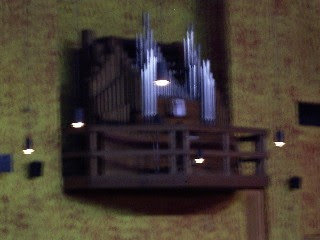
What happened in 1979, I have no idea, but when I first visited the church in 2006 there was definitely an organ, I never heard it played, but it was there. Obviously no one thought it interesting enough to take a picture of because I have scanned the web and can find nothing. 2006 organ However, a friend of mine did find this photo in her collection, rather out of focus, but clearly an organ. Apparently this organ became “unreliable” due to the hot air heating system in the church and so it was removed when the church was refurbished in the winter of 2008/2009.

I personally thought the church was a better place without that organ. An organ of that size seems to be out of place and too overwhelming for the services in Taizé. However, a new organ had been commissioned from Gerhard Grenzing, an organ builder from Catalonia. Rather unusually for a organ, part of the specification was that it had to be “quiet”! When I saw the new thing arrive I thought it looked as if it could blast you out of the church, but apparently the sound is very much in keeping with the quiet meditative nature of the chants. 2009 organ Also interestingly the organist sits sideways on to the church so that he does not have his back to the congregation. This must make it easier for the organist to still feel part of the community of singing.

Finding all this out, has made me hanker for more information. What happened in 1979? Why have there been so many organs over the years? How many have there actually been between 1979 and 2006? Maybe some of our new friends who have been coming to Taizé for years will be ale to fill in some gaps, I don’t know, but I will certainly keep digging. So anyone with any information or any photos throughout the years, let me know!

La Tuilerie Website

Monday, 31 May 2010

Portes Ouvertes

Vignerons de Buxy“Portes ouvertes” are quite frequent events around here. The words literally mean “open doors” and most businesses choose one weekend a year to open their doors to the public, let the public sample their produce and generally have a good snoop around. It is a nice way to see a business, but usually you can sample their produce any other time so what is the big deal? The Vignerons de Buxy (the place we buy most of our wine) had an open day last weekend. Having worked in the food industry for many years, the thought of seeing lots of stainless steel vessels, pumps and pipework was not something I really needed to do, particularly in a crowd, but Cees persuaded me to go.

We arrived in Buxy and the place was heaving. There were two huge catering tents outside and a band was playing very swingy music. There were stalls selling local produce, cheese, honey and a basket weaver making and selling baskets. It was one huge party. We arrived just after lunch to avoid the crowds, not realising that you could have lunch in these tents, for a VERY reasonable price. Ah well, that was one culinary experience we missed out on. So straight into the cave itself. We were handed a glass as we entered and a little map of the tour and down we went into the cellars to follow the arrows.

Wine barrelsAs we entered the basement, we were given a piece of paper, which had various questions on it, a bit like a treasure hunt and off we went to find the first answer. The first part of the tour was in the very dark cellars with all the oak caskets, they were massive, I had no idea they would be so big. Then on to the stainless steel tank room. Again all much bigger than I had expected and then on to the grape handling areas, where grapes are crushed, separated, tested and mixed to give the right juice and also where the first fermentation took place. What really made it interesting were the signs that had been put up all over the place explaining what happened when in the process.

At different stages on the tour there were red wine, white wine, rosé and crément sampling points. There were small cookery demonstrations, food sampling, a large display of all the flavours that go to make up wine, vanilla, blackcurrant, mushrooms and many others that I can’t remember. All of this had been put in place to enhance your perception of the flavours when tasting the wines and to demonstrate how certain food complement and even alter the taste of the wines.

Basket weaverWhen we had answered all the questions on the treasure hunt form, we posted it in the box at the exit, there was one magnum an hour to be won, but no on has been round with our magnum yet!

After all that, there was a mini-bus tour of the vineyards, but the queue was too long by that time, so we didn’t bother to wait. I think you have to be early if you want to do that.

The doors opened at 09.00, lunch was available from 12.00 and in the evening there was a concert which started at 20.30 after which a simple evening meal was served. Bravo to the Vignerons de Buxy, they really pulled out all the stops for a very interesting and fun day.

Buxy is in the Côte Chalonaise region but the Mâconnais, Beaujolais and Côte d'Or are all very near here, so we will be keeping our eyes open to see when other caves in the area are having their open days, these are “portes ouvertes” well worth visiting.

To have a look at the website for our gites click here.

Thursday, 27 May 2010

BIG NEWS!!!

Fifi just before birthingFor all our Fifi fans out there, we have BIG news. Fifi has been getting rather tubby these last few weeks, but there again she has been tucking into a lot of mice and moles. I had my suspicions that she might have had a secret romantic liaison, but Cees was not convinced at all (typical father). Anyway the last few days she has been very clingy towards us and on Wednesday she did not move more than a few feet away from our front door. I was fairly confident that she was going to produce a couple of Fifiettes and sure enough as the evening wore on, it looked like she had gone into labour. She was insisting on staying our front door mat, not an ideal place to birth her litter, but Mum should know best. At about 7 o’clock after a failed attempt to climb into a removal box full of kindling, she finally moved off to her cubby-hole and into her own bed. One by one she produced her offspring. When we left her at just after 12 o’clock there were three and by Thursday morning there were four squeaking mouse-sized animals to be seen.
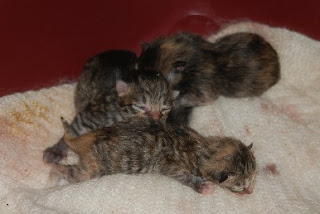
Fifi's babies She has let us pick them up and stroke them - so much for my worries about not being able to get near the litter. At the moment all is calm around La Tuilerie, Fifi is looking after the little ones in her own house, but who knows what chaos they will cause when they are capable enough and brave enough to walk out and about on their own.

For those who have missed previous Fifi postings click here.

Saturday, 22 May 2010

Concert Season

Throughout the summer, there are concerts every weekend at various villages around here. Most are played in the Romanesque churches that almost every village seems to have. I don’t know what it is about these churches, but their acoustics are quite amazing. The start of the season tends to be Easter, but then there is a lull until Ascension Day when the real summer season starts. When we lived in The Netherlands, Cees and I always used to go on holiday on Ascension Day as it meant we could squash in the most bank holidays into our holiday period, four weeks off for just three weeks holiday!

Roundelay This Ascension Day we went to one of our favourite concerts of the year. There is a Dutch madrigal choir that comes to Chapaize every year where they give a free concert. The standard of the concert is very high indeed and it is difficult to imagine that these are all amateurs. One couple in the group have a holiday home in Chapaize and the concert is given each year to raise money for the renovation of the two churches in the commune of Chapaize, the Chapaize church itself and the church in the hamlet of Lancharre. Whilst the concert is free, you are encouraged to donate money as you leave the church and people donate generously, I didn’t see a single coin go into the collection baskets held by the choir members’ children.
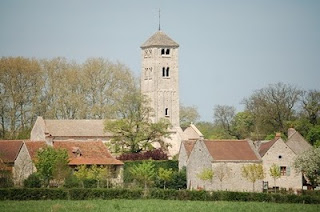

This concert is part of a series called Chapaize Culture. These are held in the beautiful Romanesque church in Chapaize, just down the road from us. Another very popular music festival is ”Guitares en Cormatinois” held every year in churches in and around Cormatin.

As I mentioned in a blog last summer, there are free walk-in concerts all over the place during the summer months, in particular Chapaize, Brancion and Tournus and we have even been treated to an impromptu concert in Ameugny. One year we were there looking for the secret inscription and we heard singing and went in. Going into the church when there is music adds a new dimension to these magnificent buildings. Click here to see when are where the regular ones are.

ChapaizeBurgundy is blessed with an enormous number of Romanesque churches. Cluny was the centre of the Christian world for a while and this is one of the main causes. But there were other powerful forces in the area one of which was Brancion and they too built Romanesque churches to ward off the local influence of the Abbey in Cluny. That coupled with the enormous wealth of the area at that time and you end up with a lot of buildings. Chapaize and Lancharre are just two of the churches that fell under Brancion. Now, 1000 years later, Cluny has only part of its abbey left and Brancion doesn’t even have a town hall any more, it is attached one of the villages down the road – how the mighty have fallen! Having said that we still have the beautiful remains of their power struggle.

Just a couple of tips if you want to go to a concert in Chapaize, take a cushion to sit on, the pews are murderous. And don’t worry about getting the “best seats” at the front which everyone fights over. We turned up very late the other day for a jazz concert in that particular church and ended up being stuck right at the back. For me (at my height) that means you can’t see a thing, but the organisers said “Don’t worry, most people don’t know this, but you actually have the best seats in the house” and he was right, the focus of sound seemed to be right where we were sitting. Now I understand why the organisers of these concerts always sit at the back.

Our website latuileriechazelle.com gives lots more information at the bottom of the tourist page about things going onin the area.

Sunday, 16 May 2010

The Ice Saints

Saint SophiaIt was 15th May yesterday and we went to Cluny market to get some tomato, courgette and cucumber plants. Every other stall was selling plants, because NOW is the time to plant. The last of the Ice Saints has had their day and so today I will be in the garden putting my precious plants in the ground.

The Saints de Glaces are big in this country, they even get a mention on the weather forecast although Evelyn (France 1’s weather reporter) was quick to say that they are not a meterological phenomenun, but still this year the news is full of them.

The old wives tale goes that you should not plant out non-hardy plants until after the Ice Saints name days: St. Mamertus – 11th May; St. Pancras – 12th May; St. Servatius – 13th May; Bonifatius – 14th May and St Sophia (Cold Sophie) – 15th May. It is said that these days always produce a dip in temperature, bad for the settling in and growth of new plantlets and it is also said that after these days there will be no more night frost. But is it true? Actually it isn’t true. There is a dip in temperature that can be seen in the middle of May, but it is in fact around the 20th.

Rome changes the saint name days every so often to reflect the changes in society, different names and to try and eliminate the influence that paganism and superstition still rife in many areas of the church. Just take the date of Christmas, this date has nothing to do with the birthday of Christ, the date was chosen to coincide with the old mid-winter festival, trying to woo over the pagans in early Christian times. That is how the Ice Saints got their nick-name, they just happened to be saints allocated to the cold days in May. Many farmers prayed to these saints to protect their crops and in the 1960s name changes, the Ice Saints were eliminated to stop this idol worship and superstition. St Estelle has replaced St Mamertus, St Achille replaced St Pancras, St Roland replaced St Bonifatius, St Matthew replaced St Servius and even Cold Sophie has had the chop, being replaced by St Denise. It doesn’t stop this period being called “Saints de Glaces” though.

I myself grew up with “Ne'er cast a clout till May is out”. Clout meaning (winter) clothing and May refering to the May flower (hawthorn blossom). So it is saying summer has not arrived until the may flowers are in full bloom. Around here, that is usually around the 20th May. Ah ha, back to that date again.

 So it appears that the saints have got it wrong. A little more searching and the mystery is solved. The Ice Saints had it right all along, it is all down to the fiddling of dates by the Catholic church again. Pope Gregory VIII rearranged the calendar in 1582. Cold Sophie was 15th May in the Julian calendar, that date stayed with her, but her day was effectively moved in time. If we were to put Sophie back to her real day (not date) she would have her day on 22nd May, which means that the Saints de Glace are in fact 19th – 22nd May in today's calendar system, corresponding exactly with the meteorological phenomenon of the temperature dip and my Mum’s favourite “clout” warning.

So I shouldn’t be planting today at all, but in 5 days time. Looks like my little plants will have to wait a couple more days until Cold Sophie has gone.

Monday, 10 May 2010

Horses in Cluny

Since my blog back in November last year about the Haras Nationaux (National Studs) branch in Cluny closing down, it has been announced that this Haras has been given a reprieve for at least the next ten years. Cluny Show JumpingThere was a great sigh of relieve in Town and it has somehow rejuvenated the town’s horse connections. After a lull when the imminient closure was announced, works have restarted on at the Equivallée (the show jumping facility) and have been going on all winter with a fascinating array of different layers being added to the all-weather rings and now there are two fully up and running all-weather rings, the grass ring, which has had some of the pressure taken off it, is in excellent condition and there are two practise rings as well..
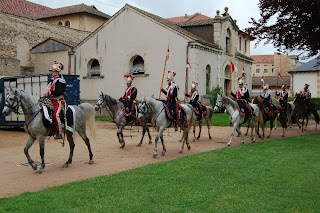
Since the spring, there seems to have been at least one event every week. We have stumbled across various shows and jumping events in and around the Haras. This does tend to disrupt the traffic through the town as the temporary stables are on one side of the main road and the Equivallée is on the other, but it does brings a lot of life into Cluny.

Cluny Parade Last weekend’s event was an auction of thoroughbreds. The auction started at 10.00 according the posters but, as veterans of Cluny events, we decided to arrive about an hour after the published starting time in the hope that things had got going. We were entertained to a number of demonstrations in one of the all-weather rings amongst which there was a cowboy like chap breaking in a young foal. We also saw the officials from the Haras parading round the Haras itself, then into the Equivalée and there were loads of stalls selling all sorts of horsey things including some ghastly 70’s looking horse paintings on velvet. But sadly no auction.

We asked a number of official-looking people what time the auction itself would start and had varying answers from “any minute now” (accompanied by the dangerous word normalement which usually means, I haven’t a clue when) to “in about an hour’s time”. However, we were already approaching 11.30 so if you add an hour to that you are well into lunchtime. As nothing happens during lunch round here (12.00 – 14.00), our educated guess was that the auction would not actually happen until about 14.30. Just in case we were wrong, we hung around until 12.00 then sadly we had to leave as were expecting guests in our gites.

With the amount of activity going on, in and around Cluny this year with Cluny 2010, I am sure we will bump into some more horse events, so at the end of the day we weren’t too disappointed.

Our webiste La Tuilerie de Chazelle.

Sunday, 2 May 2010

The Bells, the Bells!

View of La Tuilerie from Taizé
I’ve mentioned before that the bells of Taizé are the first thing I hear when I wake up in the morning, OK I know I should be up before 08.15, but that’s life in Burgundy for you. In fact I was told that the reason that people sleep so well here is the extra oxygen in the air from being next to the forest. As you can see from the photo our house is nestled amongst the trees and when people come to stay here it is true that they sleep very well and deeply. I had always thought that it was the long journey they had just made, or the fact that at last they can sleep somewhere where there is no light pollution or somewhere where it is truly quiet, but Mme R reliably informed me that it is the potency of the air that does it.

Now Mme R is an interesting person, she has lived here all her life, she has an ingrained disrespect for all in authority be that local government, the police, the Catholic church or anyone else who puts their head above the parapet and she has an opinion on everything and she “knows” a lot. We love to listen to her rantings about local dignitaries, in particular the one about the Mayor (not ours I hasten to add) who was caught stealing milk from a neighbour’s farm to make cheese. His cheese farm is out of bounds to us now, we are not allowed to buy from there in case we incur Mme R’s wrath. She has a host of such stories which all go together to prove her general conspiracy theory of authority figures.

We were at Mme R’s house one day a couple of years ago when the Taizé bells started to ring and that prompted a story about how there had been a pond under the bells originally, to act as a “sound mirror” to reflect the sound far and wide. The local villagers had complained about the noise and these complaints had prompted the monks to change this situation. Another conspiracy theory, but at least the monks did the right thing in the end. We take these stories with the pinch of salt that they deserve, but we enjoy them none the less. Oh yes and don’t get her started on windmills, we have had too many hours of stories of money grabbing officials just after lining their pockets with gold at the expense of us residents!

The original Taizé bell tower
The other day I found a picture which shocked me to the core, I dragged Cees over to look at the picture and we finally agreed that some of what Mme R had told us was in fact true. As you can see in the photo, when the bells in Taizé were originally installed, they were indeed installed over water. What’s more, they were in a completely different tower construction, much more open and no more than 1 m from the ground with a small pond underneath. Also this old tower was in the middle of a large open space in-between the living accommodation of the monks and the new church. Those bells must have been deafening for many villages around. No wonder there were complaints!

Having said that the original bell tower is aesthetically pleasing to look at unlike the truly ugly gate-like construction the bells now hang in. However with the bells now at a height of at least 10 m above the ground, with them being relatively boxed-in in their new tower and of course with there being many new buildings around the bell tower, the sound of the bells is very pleasant indeed and not a bad sound to hear when you first wake up.

So I think an apology in order here: Sorry Mme R we will believe you next time!

For more photos of the house and where we are Click here.

Monday, 26 April 2010

The Season Starts Again

Although we are officially open from the beginning of April, our renting season normally starts about mid-April and this year was no exception. A gentle start to the season with just one rented out, but now both are full. It is always nice to have people return and both last week’s guests and one couple this week have stayed here before. It is like welcoming friends back again and it is this mix of old and new faces that keeps us enjoying the work we do. My Dutch gets a bit rusty over the winter as Cees is too good to me and speaks mostly English, so I need those chats over a glass of wine with our guests to get me back up to speed.

Henk chopping woodBut last week’s guests always keep us on our toes when they are here. I am exhausted after a week with Henk. He can’t sit still for one minute and he is always looking for things to do. He spotted a pile of logs that were too large for our wood burning stove and which we have miserably failed to split into smaller logs and he found a large axe, and with a quick “do you want these spilt?”, he was away. Just one skilful whack with the axe and these stubborn pieces of oak gave way, leaving us to run around and stack our new ready to burn logs.

It is not only wood chopping, but Henk is a fanatical gardener. He helped me enormously last year to get the vegetable plot into some sort of order and this year, he came to inspect what I had done over the last year. Henk in the garden I think he was rather disappointed that I had managed to keep it going as he had little digging to do, but he was kept happy by setting up a new bed for me, making the garden complete, well at least until next time he comes.

After planting a walnut tree, a rose and clematis that will grow through the dead apple tree in the orchard and helping me sort out the wild flower area in the front garden, he was done for this year. He even had time left over for long walks and cycle rides with his wife Gerda. So thank you Henk and Gerda for a most fruitful and enjoyable week. I’d better keep the garden looking nice now in case they come back again.

So I am relaxing after a busy week, feeling charged up for the new season ahead and looking forward to the first campers.

More information about are gites and campsite are here

Sunday, 18 April 2010

Les Conscrits

Every year since we have lived here, we have seen a large banner across the street in March in Cluny, announcing that the “conscrits” of a particular year have their reunion on a certain date. The only thing we could think of was some sort of reunion for people who have done their national service. As I have never done it and Cees would rather forget his, it was never something we were particularly interested in.Me in my tophat Then one day in December last year there was a little notice popped into our letterbox announcing a pre-meeting to prepare for this event in Cormatin for the conscrits of year zero. This intrigued us. So we started asking questions and it appeared that it had nothing to do with conscription, it was just a party for everyone who was born in a year ending on the same number as the current year. So in 2010 it was the zeros and guess what, my birth year ends on a zero (yes I’m thirty again this year!).

So off I went into the snow in January to the first meeting to discuss our party. We were joining up with Ameugny, Taizé and Malay and all their little hamlets and basically it turned out that we were having a lunch to which we could invite friends and family as well. Sounds fun, I thought. No one on the organising committee realised of course that I had no idea what this was all about, so at each meeting a new little twist to the story was revealed, first it was marching up the main street, then it was hats and rosettes, then it was a six course lunch, then it was a cabaret act, then it was music till dawn, then it was onion soup before you went home and to be honest it all sounded rather complicated. To cut a long story short, My Day was yesterday.

At the allotted hour I arrived at Cormatin Chateau car park ready to set off. Everyone was issued with top-hats and rosettes in a colour according to their age, each age-group linked arms with the others in the same colour and off we went in age order, the ten year-olds at the front and the 90 year-olds at the back. The wave of Amity A car in front of us played suitably jolly music to walk to and a car at the back carried a couple of 80 and 90 year-olds who felt they couldn’t make the walk up and down the main street. The traffic was stopped by guys in fluorescent jackets as we did the traditional wave-walk up the street. Each line of people zigzaged across the road right to left, then left to right, creating a “wave of amity” as we flowed up towards the road to Chapaize where we stopped for breath and to let the traffic through. We then turned round and walked back up to the church and the war memorial where a wreath was laid, then on up to Salle St Roch for kir and nibbles, all the time making sure your hat and rosette stayed in place.

After photos, we went for lunch, by which time it was 2 o’clock. The six course meal rolled on, quite superb food was laid on by the restaurant at La Place.Menu I’d warned them of my fish allergy earlier in the week and they coped extremely well, getting me a very similar looking dish at the same time as the other 70 odd guests were fed, very unlike many restaurants who make you feel two inches high for daring to be allergic to anything and making sure everyone notices you have something different. In-between courses there was dancing and then the cabaret act arrived to entertain us. The cheese course (which come before dessert in France) arrived at 6 o’clock and as we had gîte guests arriving, we had to skip dessert and coffee. So who knows what time the coffee arrived! One person we bumped into today said she had left “early” at 3.30 in the morning, maybe the youngsters managed dawn and their onion soup, I don’t know!

So what was it all about? We were right with our original assessment that it was something to do with conscription, albeit very vaguely. Young men were conscripted at the age of 20 and the evening before they went into the army they had a huge party and then marched out of town en-masse arms linked. This tradition seems to have started not so far from here in Rhône, possibly Lyon, but most probably Villefrance. As conscription disappeared, the party was not forgotten, it has been extended to include young women as well as men and to include not only the 20 year-olds but also everyone who’s age is a multiple of ten years. Apart from laying the wreath at the war memorial, its military origins are long forgotten.

I must say it was one of the silliest things I have done in a long time, but it was fun to be a part of it and I’m looking forward to my next 0th birthday, I think I’ll wear blue that time!

La Tuilerie Website

Saturday, 10 April 2010

Burgundy Awakes

primulasBurgundy hibernates in the winter. Even though you can still have tee-shirt weather into mid-November, Burgundy effectively grinds to a halt towards the end of October. The museums, the Château in Cormatin, the caves in Azé and Blanot and other attractions all shut down, the bicycle renter closes his doors and the tourists stay away. That is why our gites are not open after the end of October, very few visitors come and so we drain down the water and tuck up the little houses putting them to bed for the winter.

But just as suddenly as winter arrives, so it ends. This last couple of weeks have seen almost everything in nature coming into action. The forsythia is in full flower, the daffodils, the primulas, the wood anenomies, blossoms of all sorts, even the tulips are flowering, the birds are singing their hearts out and the frogs are almost deafening, everything seems to be bursting with all that energy that has been pent up over the winter months. The Easter week sees Taizé literally explode with people, whereas two weeks ago I had the pick of anywhere I wanted to sit, if you are not in at least half and hour before the start of the Easter Sunday service, you won’t even find a square centimetre of floor area to park your bottom on. Talking of parking, Taizé is sheer lunacy at this time of year, I prefer a leisurely walk over the anarchy of fighting your way through the buses and people with a car.

cockrel at LouhansBut on Easter Monday Burgundy is really shaken alive. It is the first Louhans small animal market of the year. The whole area becomes one great big party. The normally sleepy little town is turned into an enormous market place for the whole day and the fair arrives as well. Literally hundreds of thousands of people flock to enjoy this unique day of the year, which always seems to be blessed with beautiful weather. Don’t even think about trying to get a place in a restaurant for lunch, everywhere is booked up, even the kebab shop has a queue that goes half way down the main road. Just buy something off the market and set up your own little picnic. As you arrive and walk into the town centre, you will be met by hundreds of people coming the other way, carrying twittering cardboard boxes tied up with string in which they are carrying their point-of-lay chickens, taking them home to the newly prepared hen-house. The cycle of life has started again. Chickens are bought at this time of year to give eggs, then they are killed in the Autumn to provide meat, when they start their moult and stop laying. The cycle is then complete.

ducks at LouhansEverything is opening up, Burgundy is bursting with life again, the roads seem to be full of foreign number plates, a sight rarely seen in winter. We are looking forward to a fresh season, meeting new people and welcoming back old friends, sharing stories of the past year and swapping news. The gites are painted up and ready to roll, all the winter maintenance has been done and now life speeds up to a leisurely amble as we stretch our legs and shake off the winter cobwebs.

La Tuilerie Website

Friday, 2 April 2010

The Church in Taizé, Now and Then

Romanesque chruchAs readers of this blog will have noticed, the church at Taizé fascinates me. The last time I wrote about it, I wrote how the church expands and contracts with the seasons to accommodate more or fewer people (see here). But in this blog I am going to attempt to reconstruct its history.

When Frère Roger returned to Taizé after the war, he returned with three like-minded individuals and this was the beginning of the Taizé order. However, the order was not formalised until a couple of years later when the Taizé rule - a “parable of community” – had been written. On Easter day in 1949, seven brothers committed themselves to a life following Christ in simplicity, celibacy and community. This small community celebrated their daily rites in the Romanesque church in Taizé. This church is very small and as the numbers of summer pilgrims increased, the church became too small to house everyone who wanted to take part in the services. So early in the 60s it was decided that a bigger church be built.

1960s churchAfter the war, a German Christian movement was set up, by volunteers, to help countries who had suffered under the Nazis. It consisted of a group of architects who’s intention was to build symbols of reconciliation in places where the war had caused great pain. This group was called Aktion Sühnezeichen Friedensdienste, or Action Reconciliation Service for Peace (ARSP) and it still exists to day. It was in the early 60s that ARSP decided to work with the Taizé community to build the Church of Reconciliation. The monks designed the church and with the assistance of ARSP architects, its volunteer youth workers and other Taizé volunteers, the church rose out of the ground.

1980s church with tentThe floor area of the Romanesaue church was roughly 90 mˆ2, capable of housing 90 – 100 worshipers and the new Church of Reconciliation was about 1,020 mˆ2, well over ten times the size. It was a huge leap of faith to believe that this new church could ever be filled. But by the early 70s it was obvious that the community had in fact underestimated the size of church needed and in the height of those summers it had to erect circus style tents by the front entrance to increase capacity.

2000s churchThe tents were one option, but in the early 90s a more permanent structure was conceived and planning permission was then given to increase the size of the new church. The church has been added to over the years with extra length and extra wings so that the church is now not far short of 4,600 mˆ2. It has to be said though that even now in the height of summer the Saturday evening and Sunday morning services attract more people than the church can hold and many of the faithful have to follow the services from outside.

So in the course of 50 years the capacity of the church has increased from a tiny village church to a huge building which is ¾ of the size of St Paul’s Cathedral in London. It is now difficult to imagine that this was ever just a small community of 7 monks.

Our website gives information about the accommodation we have available.

Saturday, 27 March 2010

Hunter Gatherers

The rural French have a close link to nature. If there is something that nature is offering for free they will be out there to make sure it does not go to waste. At this time of year the local villages make money out of daffodils, not by picking and selling them but by setting up a stall selling wine and other goodies, near a spot where people come in their thousands to pick these wild flowers. Each village jostles for the most customers by putting up competing signs ranging from large wooden daffodils to the more subtle and enticing signs simply displaying the magic word “Jonquilles”. Jonquilles/wild daffoldils The roads are made unsafe over the two to three weekends spanning the flowering period as loony daff hunters zoom around zigzagging across the countryside heading off to find the best spot to pick as many daffodils as they can carry, preferably not too far from a parking spot and of course as close as possible to a wine selling stall to refortify themselves after their hard labour of plucking these delicate blooms. Even on weekdays, the really canny pickers go out choosing a day that they think is the most likely to yield a good harvest. So the wine stalls are manned almost 24 hours a day to maximise sales during the picking weeks.

If nature were left alone, vast areas of forest around here would be great swathes of yellow, but the intrepid French have been out in their thousands, making sure this is a sight that no one will ever see. Maybe I am being a bit dramatic, but I can’t get my head around picking wild flowers. Since I was a small child it has been drummed into me that this is just not done, flowers should be left in their place for all to enjoy, not selfishly stolen for the pleasure of just one person. Having said that, in this instance, the French might indeed be right in what they are doing.

At this time of year (and for the coming month or so), my previously adopted homeland, The Netherlands, has huge fields in the north west that are ablaze with colour as the hyacinths, daffodils and then, more famously, the tulips come into flower. Whilst some of these flowers will end up in a vase, the vast majority of bulbs are being grown to be sold as bulbs. Tulip field So huge lawnmower like machines drive over the fields when all the bulbs have come into flower and the flowers are cut off, leaving only the leaves standing. This allows the bulb itself to strengthen and develop into a saleable product. The flowers are then dumped at the end of the rows as a splash of colour. So maybe what the locals around here are doing, is in fact beneficial to this wild species and not what I would call it - stealing from nature - I don’t know. In any case I couldn’t bring myself to pick even one little flower, it just didn’t seem right.
I did have a glass of wine though - just to support the local economy you understand!

Check out La Tuilerie Website for more picture of the fauna and flora around here.

Sunday, 21 March 2010

First Cycle Ride

ChapaizeIt is the middle of March and as is usual around here, the season has changed from the depths of winter to nearly summer. Some people call it spring, but spring is really an unknown season here in Burgundy, the weather changes like a light switching on and off. Tuesday night was minus 4 degrees and Thursday it was 18 degrees in the shade. That is not to say we won’t get any more frosts, the old saying “ne’er cast a clout till May be out” is just as true here as it is in the UK, but it looks like the summer is arriving. The birds are going crazy, all the trees have sprung new green life, the herbaceous plants are shooting out of the ground and Cees has got our bikes out of the shed.

Thursday was the first chance for us to go for a cycle ride in comfort in months and it was lovely to be out and about on the Voie Verte again.  I thought my cycling days were over when I left the Netherlands to come and live here (I only do flat) but the Voie Verte which runs very close to our house, is an old railway line that has been converted into a cycling path. It is safe and almost flat. The path travels from near Chalon-sur-Saône to Mâcon in almost one smooth ride. A bit of a warning about Cluny to Mâcon though, whilst there is the interesting Tunnel du Bois Clair, the path is very steep in places, far more than I can do. Having said that, we have had campers or people in the gites here that have even managed to do it on a normal bike however, a mountain bike and strong legs would be more appropriate.

So off we went, rather unfit after our winter of doing no physical activity and we set off on the boucle that goes past our property.  There are a number of boucles off the Voie Verte, they are graded signposted tours that give you access to the many interesting villages around here. The grading goes from one spot which is easy up to four spots which is very difficult (the trip to the tunnel for instance). So we chose an easy boucle for our first outing. This particular one goes up through the forest to Lys with its assortment of artisans (pottery, blacksmith, tapestry maker) and of course the adorable little church with relatively well-preserved wall frescos and then on to Chapaize with a church tower that can be seen for miles around but when viewed from the village itself definitely seems out of proportion and finally, all the way downhill, back into Cormatin. About 15km in all and it took us less than one and half hours after stopping to see the churches and having a beer in Cormatin to fortify us for the final leg back home.

We came home to find a happy little cat wanting to play and so we got the garden chairs out sat down had fun playing with her with string and ping pong balls. A very relaxing end to a beautiful day and hopefully the start of summer.

For a link to the Voie Verte check out the tourist information page on our Website
Related Posts Plugin for WordPress, Blogger...