
 One of the walls of the ancient abbey church was lit up with the words “Towns like dreams are made up of desires and fears, even if their way of presentation is secret, their rules are absurd and their perspectives are faulty; and everything hides something else.” Very thought provoking and intended to set the scene for the actors to appear and walk around the predetermined route through the streets, gardens and alleyways of Cluny to one of the spots where their little piece of theatre was to be played out, with us amongst the thousands following them eager to discover what secrets were to be revealed.
We were treated to dancing, folk music, recitals and theatre pieces, all intended to reveal the secrets of Cluny’s past, present and future. There were numerous people on top of walls, suspended from ropes or bits of cloth, we tripped over loose cobble stones and fell over low walls,
 I got my foot trapped between a branch and a step as we stumbled through someone’s garden (now destroyed by the thousands of feet that traipsed over it in the last couple of days), skirts dangerously brushing against the candles lighting the way and all this without a health and Safety officer in sight to put a stop to the fun! In order to dodge a carelessly steered child’s pushchair, Cees climbed over a pile of ivy on the ground, rather than walking round it like the rest of the crowd and narrowly missed the face of a young lady lying there. I think she can claim the award for the most dangerous job of the weekend!
At the end of the tour after having had all of Cluny’s secrets revealed to us, we once again arrived in the market square where the winning entries in the “Cluny letter” competition were being read out – we hadn’t won, in fact Cees pointed out that we had in fact “lost”, but I prefer to take a more “Olympic Games” view about it all..
After listening to speeches in the Abbey gardens from the Mayor of Cluny amongst others, we sang the European “national” anthem Ode to Joy in French, German, English, Italian and Slovakian, then again in French. The English version included the words “All mankind are brothers plighted” which sounded painful to me and even though our friends reminded us that they had once “plighted their troths” and it wasn’t all that bad after all, I still looked the word up when I got home. Finally a film created by the ENSAM students of how the Abbey church Maior Ecclesia had once been, was shown on a huge screen in the gardens, a superb ending to an excellent evening, well done the Gadzarts.
 Sunday saw the culmination of the weekend’s activities and the huge closing picnic. As last year (see here) we all brought food to share and sat with our fellow villagers, in our case dressed in white with white food and we had a very convivial meal together. After watching a display of falconry, we headed off home on our bikes down the Voie Verte back to Cormatin. A superb weekend that we will talk about for a long time to come I think.
La Tuilerie Website

 Lyon, home of Interpol, is where I had to go last week to be fingerprinted. What terrible crime had I committed, that I should be subjected to such treatment? Well it is simple, my passport had expired and I needed a new one. It may be shocking to the Brits, but the Dutch (in accordance with new European legislation so they say) insist on a set of fingerprints to get a new passport. No more “shove the old one in an envelope and a couple of weeks later you get a new one”, no you have to go in person and have your prints taken. I had visions of leaving the Consulate with black fingertips, but it is all much more modern than that, a simple scan was all that was required.
 Our theme for the day was paintings and our first port of call was the Musée urbain Tony Garnier, reputedly the largest open-air art gallery in the world, dedicated to one of Lyon’s leading architects. The museum is in fact 24 huge paintings drawn on blocks of flats he designed and built in the 1920s and they cover his work in Lyon. The last few paintings are the more interesting in my opinion as they depict various artists views of an ideal city. The one I am showing here is the ideal Mexican city.
 Another huge painting (twice the size of anything in the Musée urbain Tony Garnier) was entitled La Fresque de Lyonais in the Croix Russe area, it covered the back side of a building seven stories high and seven windows or balconies wide. At each window or on each balcony is a famous Lyonais including St Exupery with Le Petit Prince, the Lumieres brothers (among the earliest film makers in history), André-Marie Ampère of electricity fame and more recent people like Abbé Pierre the founder of Emmaus and Bernard Pivot a journalist and TV interviewer. The photo I have chosen shows some real and painted by-passers in front of the imaginary shop fronts and building entrance.
 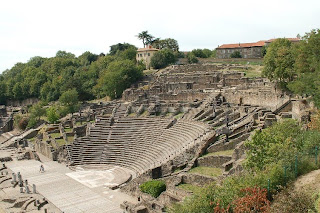 The rest of our day was taken up with visiting the Basilique Notre Dame de Fourvière, worth it for the trip in the funicular railway and the view of the city, but the Basilique itself is a bit over the top. Just round the corner was another gem, the Roman theatres. We’ve seen many in our travels around the UK, France, Spain and Italy, but this was truly exceptional. Then into the old town with the St Jean Cathedral (and ex-Taizé organ) and the traboules, a real must for anyone visiting Lyon is to zigzag through the old town using these secret covered walkways through the buildings leading to some very pretty hidden courtyards. In fact we just generally enjoyed our day in the sun soaking up the atmosphere of a very special city.
 Well it’s that time of year again folks when the winners of the annual camping contest are announced! Ooh I can feel the excitement in my readers mounting, so I will not prolong your agony any longer. There is of course always the possibility of a last minute surge from some unexpected source, but I will risk it and I am going to announce the winners today.
 In Category 2 there has been some movement, with last years’ winners sadly not being able to come in 2010 due to family circumstances, it has allowed other campers to get within grasp of the title, however the impressive score of 56 tent nights for Johan, Janine and family still proves to be unbeatable. Hans and Joke have made inroads into their deficit, however, they remain second even though they have now clocked up an admirable 48 tent nights, not far to go! Third place stays with Marijke and Dick who also managed to improve on last years’ total and are now up to 39 tent nights. The most impressive change of position came from Janine and Mijntje who have shot up from 8th position to joint 5th, partly helped by bringing their parents with them this time (maybe that is a tip to others to help improve their rating).
 Congratulations to all the winners, you can bask in your glory for another year, but don’t be complacent you never know who or what 2011 will bring.
 The Tourist Information Office has laid out a trail around town, with the intention of filling this gap. You buy the map and information from their office for one Euro and you follow the route assisted by brass plaques on the ground.
 In fact you could just use the route laid out by the Tourist Information Office and concentrate on the new boards and you will have a very good overview of the town.
 Roger stayed helping Jews and Resistance fighters until the Nazis collapsed the Vichy government and occupied the whole of France. Roger then became a target himself and he was advised to leave. He returned after the war with some friends to set up a community dedicated to help those who had suffered during the war, particularly the young people. His sister joined him, to run the children’s house. Roger was a deeply religious young man as were his friends and their vision was to create an monastic order outside of any church. This order was founded officially on Easter day 1949.
 The service was held in the open in a meadow on the edge of Taizé with the buildings belonging to the community and the Romanesque church hung with icons. An area similar to the “garden” inside the community’s church was created for the monks to be together and the service began at a quarter to 8 by singing “The Lord is my Shepherd” in Filipino, courtesy of the Jesuit Music Ministry there. The service followed the usual lines of songs and silence but with Frère Alois also addressing the congregation of about 5,000 and telling them of Frère Roger, his life, his work and the influence he had had on the Christian movement throughout the world.
 “Come round at 7 o’clock for a quick apéro and we’ll go out when no one is around.” “Pardon me, I thought this was legal?” “Well maybe it is, but the farmers don’t like it!” Thus went our introduction to this fine tradition.
 The same with the vines, seemingly tonnes of grapes are left to go to waste in the vineyards where they use mechanical pickers and Sunday afternoons in September will see hundreds of French in the vineyards collecting these left-over grapes. Seemingly nothing goes to waste, if it’s free and vaguely edible, the locals are out there collecting it.
 The abbey needed blacksmiths, carpenters, masons, wine merchants, butchers, bakers etc etc and so outside the walls of the abbey a town was formed to provide these facilities. The original town is Romanesque in style with some Gothic alterations and some later “disastrous” Renaissance rebuilding. The houses were constructed with the workshop or the shop on the ground floor and the accommodation on the first and second floors. If you look at the buildings in the town you can see how many have a large arched opening on to the street and a small door next to it which originally led to the first floor.
 Back in May we followed the walk “secrets d'escaliers” led by Corinne Loron which took us into some magnificant buildings to see their staircases. All of these buildins are someone’s home and so not normally open to the public. In July we followed “secrets de murs” with Jean-Luc Maréchal which led us around the town looking at the architectural features of the walls, including of course the claires-voies. The guides are very enthusiastic and knowledgable about Cluny’s “hidden” architectural treasures and Jean-Luc Maréchal got so carried away about the visit to his house on the first walk we did, he dressed the part.
 Last week, along with the trauma of having to collect Fifi the cat from the vet’s in Cluny, I found out that the sink discharge in one of gites has been leaking for some time, mess everywhere and only a few hours to repair the damage, clean up and dry the walls (yes the water had really been going everywhere!) So the afternoon was spent with my head under the sink with hairdryer in hand pumping hot air on to the wall, all that with 30 degrees outside. This week, it turns out that the sink in our own kitchen has been leaking down into the bathroom below, mess everywhere, call out the plumber - I didn’t dare do it myself, I didn’t know what I would find when I opened up the joint. Monsieur Kotas our trusty plumber was called and he agreed to come out on a Saturday afternoon, what a star. Job done, we now have water again in the house and not pouring down the gite bathroom wall.
 We had earned an evening enjoying ourselves and that was just what we did. We went to the last concert in the
  The public have to pay to get in and this money goes into the coffers of the Amicale a village organisation that raises funds for the old people’s annual meal and the Christmas party for the kids. This is the biggest event the Amicale organises during the year and all hands are called on to the deck to help. The work starts on the 12th collecting the tents from other villages, the tents are all built on the 13th, taken down on the 14th, then returned to their rightful owners or reconstructed at the Chateau on the 15th ready for the Rendez-Vous de Cormatin, a theatre festival which starts at the end of July.
 I left her there in the morning and phoned a couple of hours later to be told she had a smashed pelvis and a broken neck that needed to be operated on, perhaps it would be best if we went in to discuss it. When Cees came back from his tent building at the Chateau, we went off to Cluny to see the vet. We both thought it was going to be a discussion along the lines of maybe we should put her out of her misery and it was not a conversation I was looking forward to. The “neck” that was broken turned out to be the “neck” of the femur, bad enough, but not life threatening and the “chat” was just to reassure us that all would be well and we could take her home on Saturday morning, no more feeding the kittens though, so it is a good job that they have been weaned and don’t really need her milk anymore.
 Almost all of these visitors have mentioned the Silence Garden and the natural spring of St. Etienne and all have talked about how special it was.
 Dotted here and there on the grass and on the bridges were people sitting enjoying the silence, sleeping or reading. Just walking through the garden you get a real feeling of peace, people in groups talk at a whisper, but most people make no sound at all. This is in sharp contrast to the Frisbee games and general noise of the youngsters on top of the hill. I was dreading the hike back up the steep hill (244 steps I have been told), but actually it was not as daunting as I had feared and it certainly is a way to improve your fitness!
 There is an amazing variety of snails throughout the planet in terms of size, shape and colour but only one is the hero of the day. In Roman times “escargot” was considered to be a food for the elite (widely documented by Pliny the Elder I will have you know) and this Roman snail was the Helix Pomatia, now more commonly known as the Burgundy snail.
 It must be said though that our local sources are adamant that there is not a shortage of snails in either Burgundy or France, but there is however, a shortage of people who can be bothered to get up at 5 o’clock on a damp summer’s morning, who have the knowledge of which snails to choose and where to find them and who are therefore out there collecting their own. Most snail collectors round here will collect and preserve hundreds in a summer and these home preserved snails still make up one quarter of all the snails eaten in France.
 Since living here I have however, learned a lot more about wine in this area - where to buy good wine, interesting wine, cheap wine, expensive wine and we send the guests in our gites or from the campsite off to the appropriate wine cave depending on what they are looking for. We know where to go for a good tasting with knowledgeable staff and where to go for a wide range of wines and generally that knowledge is appreciated by our guests.
 We asked for a tasting and he set to, collecting bottles for us to savour. The wines were sublime and the chat and local gossip were also very interesting. We had a lesson on making Marc de Bourgogne (the local fire water), he explained how he paid the taxes on his vineyard by giving alcohol to the government - I thought Sarkozy was a teetotaller! He gave us the names and locations of all the expats he knew in the area - he knows of a lot more than us and we chatted about mutual friends. He even let us taste his “homemade” Fine which was delicious, but as he only had enough for his own consumption, we will have to wait until he bottles up the next lot before we can buy any.
 The highlight of the wreath laying is the playing of the Marseillaise which always used to be done using a crackly cassette player mounted on the boot of Monsieur P’s car which sounded like the marvellous rendition from Casablanca. But last November a brand new CD player appeared. The Armistice Day ceremony passed off with a perfectly clear well played version and it left us with a very nostalgic feeling of days gone by and the crackly old rendition of the national anthem.
 At the Bois Dernier we assumed that things were now in order, the CD machine worked and now Monsieur P knew how to work it. First hitch - at these events Monsieur P likes to play some patriotic songs, but of course when he presented his cassette to the CD player it did not fit. Not to be defeated, he sprinted back to his car opened the doors wide, blocking the road and put the cassette in the in-car player and wound the volume up. All in vain, we really couldn’t hear a thing. So on to the Marseillaise. By now even I could repeat the famous sentence “click up to number 7 then press play”, to no avail, the technology had finally beaten Monsieur P and before poor Monsieur N had a chance to rebalance his flag and get his glasses out, the CD player had been put down and with the French equivalent of “bugger this for game of soldiers” Monsieur P had started singing. It became quite evident that not everyone present knew the words, I think we managed about half of them, the Mayor – none, I’m sure Monsieur P changed key halfway through, but it was a valiant effort, even the Mayor had tears in his eyes by the end and before we went off the Les Blés d’Or for our drinks and nibbles and his final words “I think we need a different flag carrier next time”.
 Again we needed to ask a resident for clarification, yes the zone that looked like a cordoned-off crime scene was in fact the Jardin du Fouettin, possibly a wild flower meadow?
 The Jardin des Simples is right by where the entrance to the Abbey used to be and is a small well laid-out garden for herbs and medicinal plants with a few trained apple and pear trees. This garden has been growing for a few months now and is looking very good, well worth a little detour to see it. Finally on to the Rosarie.
 Anyway, next year this new feature will add a very special splash of colour to the edge of Cluny.
 In the Church of Reconciliation at Taizé there is a large pipe organ. I blogged about it last summer when it was installed, but I have come to learn so much more about it and its predecessors and yet now I seem to know so much less! By finding old photographs, I have seen that the organ in Taizé has changed a number of times over the years and it does beg the question why?
 Interestingly, I have found information about what is possibly the second organ in Taizé. This organ was built specifically for the church in 1974 by Jürgen Ahrend a German organ builder, however, that had a very short life in the church because it was dismantled and put into storage in the Bressse in 1979. Via a monastery in Switzerland this organ eventually ended up in Lyon Cathedral in 1996, where it still is today. I suspect it was rather too loud for Taizé if it can be used in a cathedral!
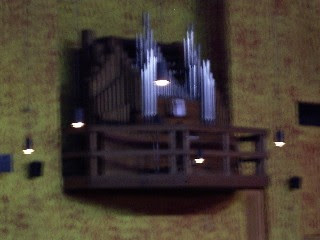 However, a friend of mine did find this photo in her collection, rather out of focus, but clearly an organ. Apparently this organ became “unreliable” due to the hot air heating system in the church and so it was removed when the church was refurbished in the winter of 2008/2009.
 Also interestingly the organist sits sideways on to the church so that he does not have his back to the congregation. This must make it easier for the organist to still feel part of the community of singing.
 “Portes ouvertes” are quite frequent events around here. The words literally mean “open doors” and most businesses choose one weekend a year to open their doors to the public, let the public sample their produce and generally have a good snoop around. It is a nice way to see a business, but usually you can sample their produce any other time so what is the big deal? The Vignerons de Buxy (the place we buy most of our wine) had an open day last weekend. Having worked in the food industry for many years, the thought of seeing lots of stainless steel vessels, pumps and pipework was not something I really needed to do, particularly in a crowd, but Cees persuaded me to go.
 As we entered the basement, we were given a piece of paper, which had various questions on it, a bit like a treasure hunt and off we went to find the first answer. The first part of the tour was in the very dark cellars with all the oak caskets, they were massive, I had no idea they would be so big. Then on to the stainless steel tank room. Again all much bigger than I had expected and then on to the grape handling areas, where grapes are crushed, separated, tested and mixed to give the right juice and also where the first fermentation took place. What really made it interesting were the signs that had been put up all over the place explaining what happened when in the process.
.jpg) When we had answered all the questions on the treasure hunt form, we posted it in the box at the exit, there was one magnum an hour to be won, but no on has been round with our magnum yet!
When we had answered all the questions on the treasure hunt form, we posted it in the box at the exit, there was one magnum an hour to be won, but no on has been round with our magnum yet! For all our Fifi fans out there, we have BIG news. Fifi has been getting rather tubby these last few weeks, but there again she has been tucking into a lot of mice and moles. I had my suspicions that she might have had a secret romantic liaison, but Cees was not convinced at all (typical father). Anyway the last few days she has been very clingy towards us and on Wednesday she did not move more than a few feet away from our front door. I was fairly confident that she was going to produce a couple of Fifiettes and sure enough as the evening wore on, it looked like she had gone into labour. She was insisting on staying our front door mat, not an ideal place to birth her litter, but Mum should know best. At about 7 o’clock after a failed attempt to climb into a removal box full of kindling, she finally moved off to her cubby-hole and into her own bed. One by one she produced her offspring. When we left her at just after 12 o’clock there were three and by Thursday morning there were four squeaking mouse-sized animals to be seen.
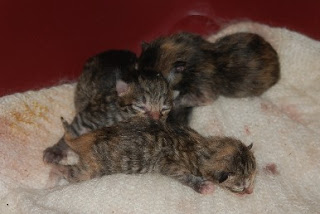 She has let us pick them up and stroke them - so much for my worries about not being able to get near the litter. At the moment all is calm around La Tuilerie, Fifi is looking after the little ones in her own house, but who knows what chaos they will cause when they are capable enough and brave enough to walk out and about on their own.
 This Ascension Day we went to one of our favourite concerts of the year. There is a Dutch madrigal choir that comes to Chapaize every year where they give a free concert. The standard of the concert is very high indeed and it is difficult to imagine that these are all amateurs. One couple in the group have a holiday home in Chapaize and the concert is given each year to raise money for the renovation of the two churches in the commune of Chapaize, the Chapaize church itself and the church in the hamlet of Lancharre. Whilst the concert is free, you are encouraged to donate money as you leave the church and people donate generously, I didn’t see a single coin go into the collection baskets held by the choir members’ children.
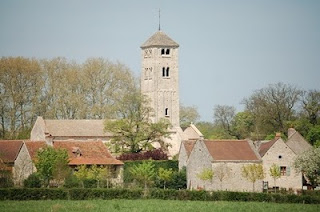 Burgundy is blessed with an enormous number of Romanesque churches. Cluny was the centre of the Christian world for a while and this is one of the main causes. But there were other powerful forces in the area one of which was Brancion and they too built Romanesque churches to ward off the local influence of the Abbey in Cluny. That coupled with the enormous wealth of the area at that time and you end up with a lot of buildings. Chapaize and Lancharre are just two of the churches that fell under Brancion. Now, 1000 years later, Cluny has only part of its abbey left and Brancion doesn’t even have a town hall any more, it is attached one of the villages down the road – how the mighty have fallen! Having said that we still have the beautiful remains of their power struggle.
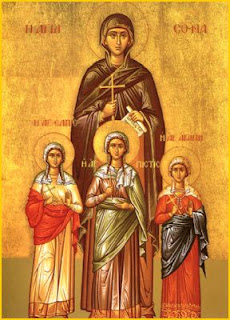 It was 15th May yesterday and we went to Cluny market to get some tomato, courgette and cucumber plants. Every other stall was selling plants, because NOW is the time to plant. The last of the Ice Saints has had their day and so today I will be in the garden putting my precious plants in the ground.
 So it appears that the saints have got it wrong. A little more searching and the mystery is solved. The Ice Saints had it right all along, it is all down to the fiddling of dates by the Catholic church again. Pope Gregory VIII rearranged the calendar in 1582. Cold Sophie was 15th May in the Julian calendar, that date stayed with her, but her day was effectively moved in time. If we were to put Sophie back to her real day (not date) she would have her day on 22nd May, which means that the Saints de Glace are in fact 19th – 22nd May in today's calendar system, corresponding exactly with the meteorological phenomenon of the temperature dip and my Mum’s favourite “clout” warning.
  There was a great sigh of relieve in Town and it has somehow rejuvenated the town’s horse connections. After a lull when the imminient closure was announced, works have restarted on at the Equivallée (the show jumping facility) and have been going on all winter with a fascinating array of different layers being added to the all-weather rings and now there are two fully up and running all-weather rings, the grass ring, which has had some of the pressure taken off it, is in excellent condition and there are two practise rings as well..
 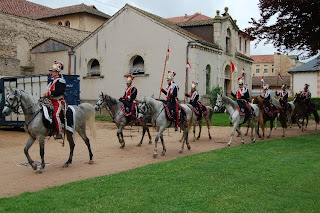 Last weekend’s event was an auction of thoroughbreds. The auction started at 10.00 according the posters but, as veterans of Cluny events, we decided to arrive about an hour after the published starting time in the hope that things had got going. We were entertained to a number of demonstrations in one of the all-weather rings amongst which there was a cowboy like chap breaking in a young foal. We also saw the officials from the Haras parading round the Haras itself, then into the Equivalée and there were loads of stalls selling all sorts of horsey things including some ghastly 70’s looking horse paintings on velvet. But sadly no auction.


